THE GRANDDAUGHTER WHO WASN'T WELCOME
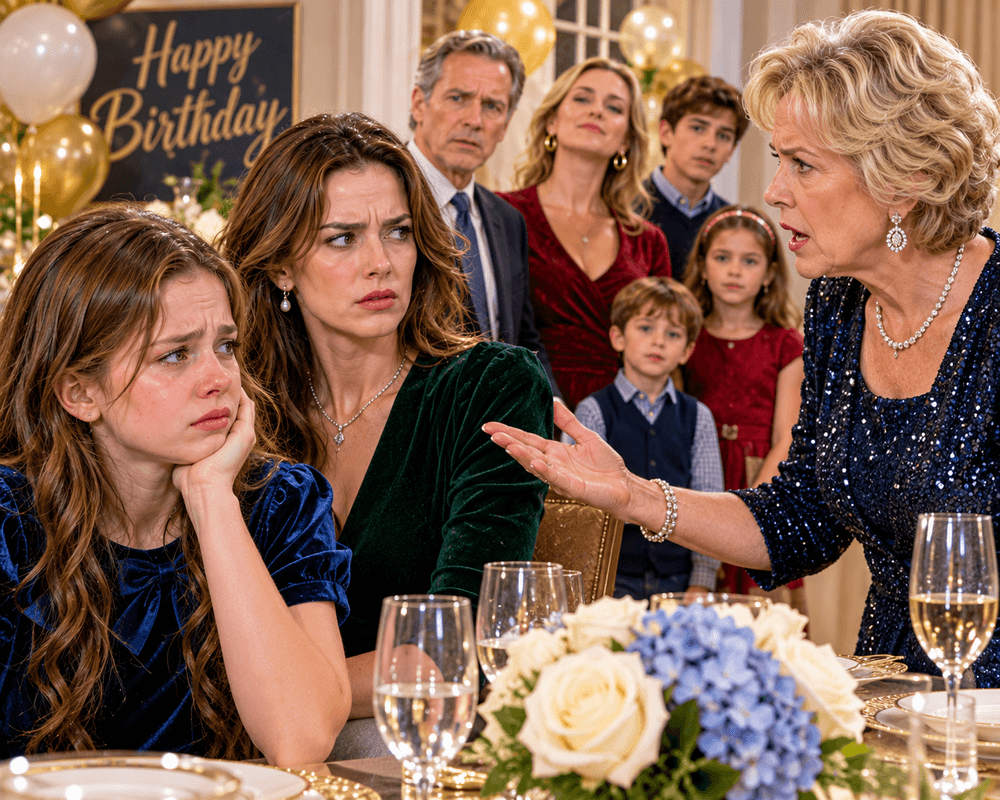
My mother announced that my twelve-year-old daughter was not invited to her birthday party while we were all sitting around the dinner table.
She said it as casually as someone might announce that the restaurant had run out of dessert.
There was no hesitation.
No awkward apology.
Not even the smallest attempt to soften the words.
“Oh, Sienna isn't invited,” my mother said, reaching for her glass of water.
For a moment, I honestly thought I had misunderstood her.
My daughter had been sitting beside me, carefully folding the corner of her napkin.
She had spent the entire evening listening to my mother describe the decorations, the flowers, the birthday cake, and the private room at the hotel where the celebration would take place.
Sienna had even asked whether Grandma wanted her to help choose the music.
She was excited.
That was what made the sentence so cruel.
My mother had allowed her to sit there listening to every detail before making it clear that she would not be allowed to attend.
I lowered my fork.
“What did you just say?”
My mother glanced at me.
“I said Sienna isn't invited to my birthday.”
Across the table, my sister Katie continued cutting her chicken.
Her thirteen-year-old son, Elliot, was showing my father something on his phone.
Her nine-year-old daughter, Ruby, was asking for more potatoes.
And five-year-old Nico was playing with a toy car beneath his chair.
All three of them were invited.
My daughter was not.
“Why?” I asked.
Mom sighed as though I had deliberately made an ordinary conversation difficult.
“Because I want an adult celebration.”
I looked directly at her.
“Elliot is thirteen.”
“He's mature enough.”
“Ruby is nine.”
“She'll be with her mother.”
“And Nico?”
Mom waved her hand.
“Those children are different.”
Different.
That word had followed me through my entire childhood.
Katie was different when she received birthday presents that cost more than mine.
Katie was different when she broke something and I was blamed.
Katie was different when our parents paid for her college apartment but told me I needed to learn independence.
And apparently, Katie's children were different now, too.
My daughter was the only child in the family who needed to understand that family gatherings were not necessarily meant for everyone.
I turned toward Sienna.
Her face had gone completely still.
She was looking at her plate.
Her cheeks were pink, and her fingers were gripping the edge of her napkin.
She was trying not to cry.
That was when I felt something inside me change.
I had tolerated years of favoritism because I had convinced myself that the situation would improve.
I had accepted excuses because I wanted my daughter to have grandparents.
I had swallowed insults because I did not want family disagreements to become permanent.
But watching Sienna sit there and wonder what was wrong with her was something I could no longer excuse.
I looked at Katie.
“You knew about this?”
She shrugged.
“Mom wants a particular kind of party.”
“And your children are part of that particular kind?”
Katie gave me an impatient look.
“Oh, Nora. Don't make this a whole thing.”
I turned back to Mom.
“You invited three children and excluded one.”
“Your daughter isn't comfortable at these events,” Mom replied.
Sienna finally looked up.
“I am comfortable, Grandma.”
Her voice was barely louder than a whisper.
Mom smiled without warmth.
“Sweetheart, this is grown-up business.”
The words landed harder than a shout.
Sienna lowered her eyes again.
My father, Robert, finally spoke.
“Let's not ruin dinner.”
I stared at him.
“You heard what she said.”
“Your mother has spent months planning this party.”
“And that makes humiliating a twelve-year-old acceptable?”
Dad pushed his chair back.
“Nora, you're making everything worse.”
I stood.
“We're leaving.”
Mom rolled her eyes.
“Don't be ridiculous.”
Ben, my husband, had been quiet throughout the exchange.
He was sitting beside Sienna, and I saw him place one hand gently on her shoulder.
He stood without saying a word.
Sienna hurried to pull her chair away from the table.
She moved so quickly that her water glass nearly tipped over.
“I didn't mean to upset anyone,” she murmured.
That sentence nearly broke me.
She was apologizing for being hurt.
I took her hand.
“You didn't do anything wrong.”
Mom shook her head.
“This is exactly why she doesn't need to attend.”
I stopped at the doorway.
For years, I would have turned around.
I would have argued until my mother agreed to pretend that she had not meant what she said.
I would have begged for an explanation.
I would have tried to convince everyone that Sienna deserved the same treatment as her cousins.
But that night, I understood something.
I did not need to persuade my mother to love my child.
I needed to stop teaching my child to tolerate people who treated her as less important.
We left.
The drive home was quiet.
Rain tapped against the windshield, and the streetlights passed across Ben's face.
Sienna sat in the back seat.
She had not cried.
She had not complained.
She had simply turned toward the window and held her small purse in her lap.
Finally, she spoke.
“Mom?”
“Yes, sweetheart?”
“Does Grandma love my cousins more than me?”
My throat tightened.
Ben looked at me, but neither of us answered immediately.
Sienna continued.
“Because she said they were different.”
I turned around as much as my seat belt allowed.
“Listen to me.”
She looked at me.
“There is nothing wrong with you.”
“Then why didn't she want me there?”
“Because Grandma made a choice that was unfair and hurtful.”
“Did I do something?”
“No.”
I spoke firmly enough that she would remember it.
“You did absolutely nothing wrong.”
She nodded, but I could tell she did not believe me completely.
When we reached home, Ben helped her upstairs.
I stayed in the kitchen, staring at the unopened message from my mother on my phone.
It read:
Please don't turn this into another family argument.
I laughed once.
Not because anything was funny.
Because I suddenly realized how many years I had spent protecting everyone else's comfort at my own daughter's expense.
Then I opened my banking application.
For years, I had been transferring €950 every month toward my parents' mortgage.
I had also sent €300 in family support and covered approximately €120 in utilities.
When Mom began planning her milestone birthday, she asked me to help organize the payments.
She opened a shared party account and connected a virtual card to it.
The account held €4,800.
I had contributed €4,200.
My mother had contributed the remaining €600.
That night, I looked at the recurring payments.
Mortgage.
Family support.
Utilities.
Then I looked at the party account.
I did not press anything yet.
I sat there until the kitchen clock reached midnight.
I wanted to be certain I was not acting out of anger.
Then I remembered Sienna asking whether her grandmother loved her cousins more.
And I understood that this was not one sentence.
It was the final sentence in a story that had been repeating itself for twelve years.
I placed my phone on the table.
Then I opened a blank document.
At the top, I typed:
To Mom, on your birthday.
I did not know yet how many people would read that letter.
I only knew that the person who received it would never be able to claim that she had not been warned.