THE CAR WITH MY NAME ON THE TITLE
The first business day after Christmas, I learned that my father had not merely favored my sister.
He had attempted to turn me into her personal bank.
My attorney, Rebecca Sloan, sat across from me in a conference room overlooking downtown Seattle.
A thick folder rested between us.
The cover bore three words.
VANCE VEHICLE TRANSACTION.
Rebecca was fifty-two, precise, and almost impossible to intimidate.
She had handled commercial property disputes and financial litigation for more than twenty years.
When I explained why I wanted to review the BMW paperwork, she listened without interrupting.
Then she opened the file.
“Iris,” she said carefully.
“Did you ever intend to buy your sister a car?”
“No.”
“Did you agree to make payments on a car used exclusively by your sister?”
“No.”
“Did your father tell you the vehicle would be a Christmas gift?”
“Absolutely not.”
Rebecca turned another page.
“Then we have a serious problem.”
Six weeks earlier, my father had called while I was working late.
His voice had sounded unusually warm.
“Sweetheart, I need a small favor.”
He claimed he was purchasing a vehicle for an investment-property management business.
His credit had suffered after two restaurants failed.
He needed someone with excellent credit to secure financing.
He assured me that he had enough cash to cover the purchase.
“You won't pay a penny,” he promised.
“It's just paperwork.”
I had refused to co-sign a vague arrangement.
Instead, I insisted that any financing be completed with me as the sole purchaser and that all final documentation require my direct authorization.
My father had complained.
But eventually, he agreed.
The dealership sent electronic forms.
I signed the initial purchase and financing documents after reviewing the stated terms.
I believed the car would be part of a short-term business transaction that my father would fund and immediately resolve.
What I did not know was that he had already promised the BMW to Chelsea.
I also did not know that he intended to leave the loan in my name.
Rebecca pointed to the financing agreement.
“The monthly payment is approximately eleven hundred dollars.”
I stared.
“Eleven hundred?”
“Yes.”
“Over five years?”
“Yes.”
I felt sick.
My father had intended to saddle me with tens of thousands of dollars in debt while pretending he had personally purchased Chelsea's Christmas present.
“Can I get out of it?”
Rebecca did not offer false reassurance.
“Possibly.”
“But not by pretending the contract never existed.”
She explained that the title listed me as the registered owner, subject to the lender's lien.
My father was not listed.
Chelsea was not listed.
The dealership's records showed that the vehicle had been released to a person my father represented as an authorized pickup contact.
The authorization trail was incomplete.
That mattered.
But it did not automatically erase my financing obligations.
Rebecca immediately contacted the dealership's compliance department and the lender.
She demanded the complete delivery file, pickup authorization, electronic signature history, and account records.
She also notified my insurer that a vehicle titled to me had been placed in another person's possession under circumstances I disputed.
Within forty-eight hours, the dealership agreed to recover the vehicle while the parties reviewed a negotiated rescission.
It was not a magical legal loophole.
The paperwork was complicated.
There were fees.
There were lender approvals.
And there was the possibility that I would remain responsible for part of the transaction.
But Rebecca had already discovered something interesting.
My father had provided the dealership with a business email address that did not match the one he used when speaking with me.
The email belonged to a company called Vance Property Holdings.
I had never heard of it.
The next morning, Rebecca called.
“Your father submitted a pickup authorization bearing your typed name.”
My stomach tightened.
“I didn't sign one.”
“I know.”
“The electronic records are inconsistent.”
She paused.
“And somebody appears to have accessed your customer portal after the original agreement was completed.”
“Who?”
“We're investigating.”
For the first time, my humiliation began transforming into something colder.
Suspicion.
I remembered how often my father had requested copies of my driver's license.
How he had insisted on maintaining access to our old joint checking account.
How my mother always seemed to know details about my finances that I had never volunteered.
I went home and began reviewing years of records.
I found transfers I recognized.
Utilities.
Medical bills.
Emergency loans.
Chelsea's rent.
Then I found transfers I did not remember approving.
Small amounts.
Four hundred dollars.
Seven hundred.
Nine hundred fifty.
The payments were spread across several years.
Most had been withdrawn from the joint account my father called our family emergency fund.
The account had originally been opened when I was nineteen.
I had continued depositing money because my parents insisted it helped them during difficult months.
I calculated the unexplained withdrawals.
The total exceeded eighteen thousand dollars.
I sat in front of my laptop long after midnight.
Eighteen thousand dollars.
That was more than I had spent on vacations during my entire adult life.
Rebecca advised me to download every statement before closing the account.
She also encouraged me to preserve messages, emails, and financial records rather than confronting my parents.
“Documentation first,” she said.
“Emotion later.”
That was difficult.
My father's voice was still in my head.
Don't be dramatic.
You're too sensitive.
Family helps family.
Chelsea needs more support than you do.
For decades, those phrases had ended every argument.
Now I saw them differently.
They were not explanations.
They were instructions.
Instructions to give.
To remain silent.
To accept less.
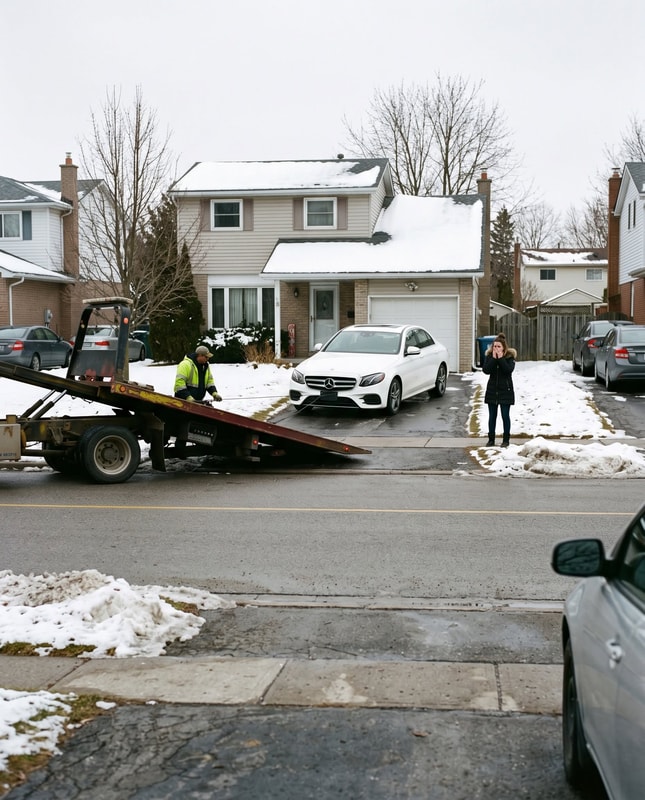
On January third, my attorney received confirmation that the dealership had retrieved the BMW from my parents' driveway.
The recovery had been peaceful, though Chelsea apparently made an extraordinary amount of noise.
The dealership agreed to hold the vehicle pending final resolution.
My father was furious.
I learned that when his voicemail reached my office.
He threatened arrest.
Accused me of theft.
And demanded the immediate return of Chelsea's Christmas gift.
Rebecca listened to the recording.
Then she smiled without amusement.
“He's threatening to report you for stealing a vehicle registered to you?”
“Yes.”
“Interesting strategy.”
“He says the sheriff is involved.”
“That doesn't establish that you've committed a crime.”
She leaned forward.
“Do not speak with him directly.”
“We'll communicate through counsel.”
That afternoon, Chelsea called the office.
Her voice shook with rage.
“You ruined everything!”
I stared at the rain sliding down my window.
“Chelsea.”
“Do you know how humiliating this is?”
“All my friends saw them take it.”
“You made me look poor!”
Her words hung in the silence.
Not frightened.
Not confused.
Poor.
That was what devastated her.
I remembered opening the plastic piggy bank.
Remembered her laughter.
Remembered my father's delighted expression as he handed her a car purchased through my credit.
“Chelsea,” I said.
“Do you still have my Christmas present?”
“What?”
“The piggy bank.”
“Are you seriously talking about that stupid thing?”
“Yes.”
“Why?”
“Because it contains two dollars.”
She made an irritated noise.
“So?”
“It's the start of your future car fund.”
For several seconds, she said nothing.
Then she screamed.
“You selfish witch!”
I ended the call.
Blocked the number.
And returned to work.
That evening, my supervisor Daniel found me staring at a bridge foundation drawing.
“You've checked that same calculation three times,” he observed.
I forced a smile.
“Being thorough.”
“You're distracted.”
I hesitated.
Daniel had always been kind, but I disliked bringing personal problems into the office.
“My family is having a difficult time accepting some boundaries.”
He nodded slowly.
“Boundaries tend to upset people who benefited from their absence.”
I looked at him.
“Where did you learn that?”
He smiled faintly.
“The hard way.”
Then he placed a small envelope on my desk.
“Your promotion bonus paperwork.”
I opened it.
Inside was a formal letter acknowledging my leadership on the firm's new coastal bridge project.
Below it was a handwritten note.
You belong here because you earned it.
I swallowed hard.
Daniel pretended not to notice.
After he left, I placed the note beside my keyboard.
For the first time in years, my work felt like more than an escape.
It felt like evidence that I had built a life my family could not define.
But at eleven that night, Rebecca sent me another email.
The subject line read:
URGENT — ADDITIONAL ENTITY DISCOVERED.
Attached was a document filed with the Oregon Secretary of State.
Vance Property Holdings, LLC.
The registered manager was my father.
The secondary contact was my mother.
And the company listed a residential property outside Portland as one of its principal assets.
I recognized the address immediately.
It was the vacation cabin whose electricity bills I had been paying for years.
Then I looked at the final page.
A scanned document identified an individual as an authorized financial guarantor.
Iris Vance.
My name.
My signature.
And a date from three years earlier.
A date when I had been in Germany attending an international engineering conference.
I stared at the signature.
It looked almost perfect.
Almost.
But the final letter of my last name curved in a way I had stopped writing when I was seventeen.
Someone had copied an old version of my signature.
And the BMW was no longer the only thing I needed to investigate.