THE WOMAN WHO OWNED THEIR CHRISTMAS
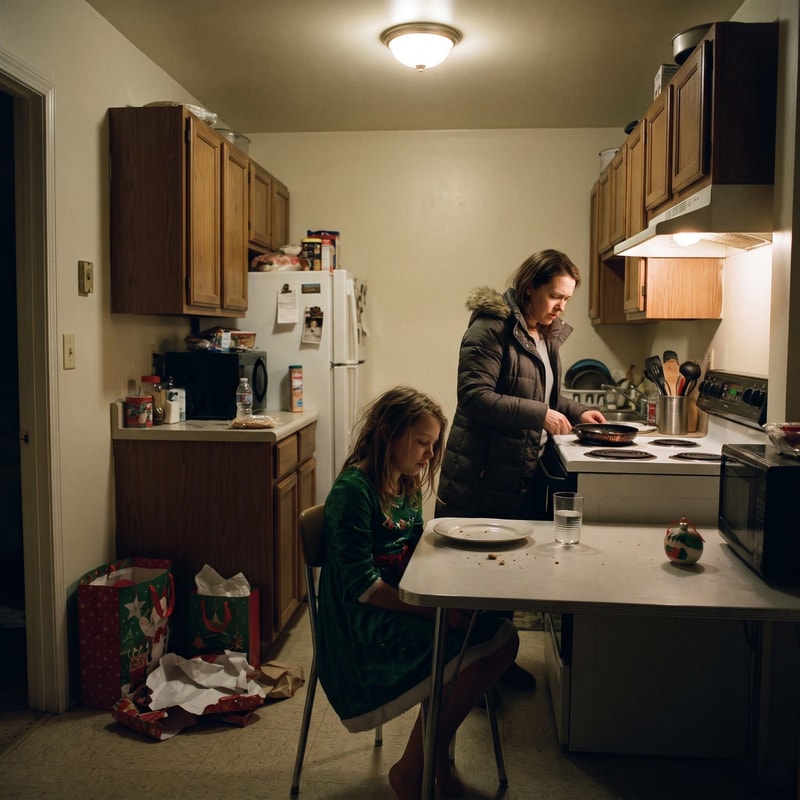
Grandma Evelyn spoke with Emma for seven minutes.
I stayed in the kitchen while my daughter sat on the couch, wrapped in a fleece blanket, holding my phone against her ear.
At first, Emma's answers were barely audible.
"Yes, Great-Grandma."
"No, I didn't cry at their house."
"Yes, I got home."
Then she laughed.
It was a small, uncertain laugh, but hearing it nearly brought me to my knees.
When she handed the phone back, her cheeks had regained a little color.
"Great-Grandma says my ornament is beautiful."
"Of course it is."
"She wants me to make her one."
I smiled.
"I think she'd love that."
Emma lowered her voice.
"She said I should make it extra colorful."
I laughed despite everything.
Grandma Evelyn had never approved of Patricia's obsession with perfectly coordinated Christmas decorations.
For decades, my mother had treated Christmas like a magazine photo shoot.
Every ribbon had to match.
Every ornament had to be positioned correctly.
Every guest had to dress appropriately for the family photographs.
As children, Dana and I had been taught that appearances mattered more than feelings.
A crooked bow was unacceptable.
A stained dress was embarrassing.
Crying in front of visitors was selfish.
And being poor was practically a moral failure.
When Emma went upstairs to change, Grandma Evelyn asked me to step somewhere private.
I walked onto the back porch.
The night air stung my cheeks.
"Tell me everything again," she said.
I repeated the story.
This time, I included the photograph Dana had posted.
I explained the empty stool.
The returned gifts.
The blisters on Emma's heels.
The fact that my daughter had tried to cook dinner because nobody had fed her.
Grandma Evelyn listened without interrupting.
When I finished, she asked, "Did Patricia contact you afterward?"
"No."
"Did Robert?"
"No."
"Did Dana?"
"Nobody."
A long silence followed.
Then she spoke.
"Ten years ago, I made a promise to myself."
I leaned against the porch railing.
"What promise?"
"That I would never again finance cruelty."
I had heard pieces of the story before.
My father, Robert Mercer, had owned a small construction supply company.
For years, he had talked about becoming a millionaire.
He drove expensive cars.
Bought luxury watches.
And insisted our family deserved the best house in the neighborhood.
Then the recession hit his business.
He had borrowed recklessly.
A major customer failed to pay.
His company collapsed.
By the time the bankruptcy was complete, my parents had lost nearly everything.
Their previous house had been sold.
Their savings were gone.
Their credit was destroyed.
My grandmother stepped in.
She bought a four-bedroom colonial house for $350,000 in cash and allowed my parents to live there for almost nothing.
My mother told everybody Grandma had given them the property.
That was a lie.
Grandma Evelyn had retained ownership through a family trust.
My parents received a conditional right to occupy the house under a written agreement.
The arrangement required them to maintain the property and follow certain family-use conditions.
One condition mattered more than the others.
The house had to remain a welcoming place for family members who needed shelter or reasonable help.
Grandma had insisted on that clause because, as a young widow, she had once relied on relatives who opened their doors when she had nowhere to go.
I had always considered the condition symbolic.
Grandma Evelyn clearly hadn't.
"Patricia signed that agreement," she told me.
"So did your father."
"I know."
"She understood what the house was supposed to represent."
I stared into the darkness.
"Grandma, I don't want you making decisions while you're angry."
"I'm not angry."
Her voice was perfectly calm.
"That is what should concern Patricia."
I closed my eyes.
"What are you going to do?"
"I am going to call my attorney."
"On Christmas?"
"Samuel keeps unusual hours."
I almost laughed.
"Grandma, he's a lawyer, not a firefighter."
"Clara, when you pay a man to protect your affairs for twenty-six years, he answers the telephone."
I heard papers moving on her end.
Then she asked, "Do you still have the photograph Dana posted?"
"Yes."
"Save it."
"Why?"
"Because Patricia will eventually claim there was no space at the table."
My grandmother paused.
"And I suspect she will soon discover that lying about something does not make it disappear."
The conversation ended shortly afterward.
I stood on the porch, staring at the dark houses along our street.
Every window glowed with Christmas lights.
Somewhere nearby, children were laughing.
Families were eating.
People were exchanging gifts.
My daughter had spent the afternoon believing nobody wanted her.
I went back inside and ordered our dinner.
For the next two hours, I refused to think about my parents.
Emma and I ate dumplings on the living room rug.
We watched a Christmas movie.
We opened presents.
She gave me a handmade bracelet with blue and white beads.
I gave her the art supplies she'd wanted for months.
When she finally fell asleep, she was curled beneath a blanket with her stuffed rabbit pressed against her cheek.
The small ornament sat on the coffee table.
I turned off the television.
Then my phone rang.
10:45 p.m.
Mother.
I almost ignored it.
Something made me answer.
"Hello?"
"CLARA!"
My mother's voice exploded through the speaker.
"What have you done?"
I pulled the phone away from my ear.
"Merry Christmas to you too."
"Don't you dare take that tone with me!"
Behind her, my father was shouting.
I heard Dana crying.
My mother continued.
"Your grandmother called her attorney!"
"Apparently."
"She says we're losing the house!"
I glanced toward Emma.
She didn't move.
"Then I suggest you talk to Grandma."
"She won't listen!"
My mother's voice cracked.
"She says we violated the occupancy agreement and she's starting the termination process!"
I frowned.
"Starting the process?"
"Her attorney sent us a notice!"
I could hear paper rustling.
"Thirty days to cure the violation or prepare to vacate!"
I knew enough about property law to understand that a letter wasn't the same thing as an eviction order.
The exact process would depend on the agreement and state law.
But my mother didn't care about legal distinctions.
She understood only one thing.
For the first time in ten years, her house was in danger.
"Clara, you have to stop this."
I looked at the little ornament on the table.
"Why?"
"Because we're your parents!"
"And Emma is my daughter."
"It was a misunderstanding!"
"An eleven-year-old child walked home alone."
"Dana's in-laws came unexpectedly!"
"Did they eat?"
Silence.
"Mom?"
"Of course they ate."
"Did Logan eat?"
"Yes."
"Did his sister eat?"
"Clara, what is your point?"
"Did everyone in that photograph eat?"
My mother exhaled sharply.
"Don't be ridiculous."
"Then explain why my daughter didn't."
She began crying.
I had heard that particular cry before.
It wasn't grief.
It was anger dressed as grief.
"You're destroying this family over a chair!"
"No, Mom."
I spoke quietly.
"You destroyed something over a chair."
My father grabbed the phone.
"Clara, listen carefully."
His voice was hard.
"Your grandmother is old and emotional."
I said nothing.
"She's making decisions she doesn't understand."
"Grandma understands exactly what she owns."
"That house is our home!"
"Then you should have treated it like one."
He swore under his breath.
"We've lived here ten years!"
"And Emma lived outside your front door for several minutes while you refused to let her in."
"You're exaggerating."
I felt my anger sharpen.
"Did you offer to drive her home?"
Silence.
"Did you call me?"
Nothing.
"Did you check whether she arrived safely?"
My father finally spoke.
"We assumed she'd be fine."
I closed my eyes.
"She's eleven."
"She's a smart kid."
"Goodbye, Dad."
"Clara, wait!"
I ended the call.
Then another message appeared.
It came from Dana.
"You have no idea what you've started."
I stared at the screen.
Before I could answer, another message arrived.
"Grandma isn't just taking the house."
My pulse quickened.
"What does that mean?" I typed.
Dana's response came almost immediately.
"Ask her about the basement."
I read the message three times.
My parents' house had a finished basement.
A guest room.
A storage area.
An old office my father used for paperwork.
Nothing unusual.
At least, that was what I believed.
Then Dana sent one final message.
"Mom says if Evelyn opens that room, we're all finished."
I stood motionless in my dark living room.
For the first time that night, my anger gave way to something else.
Fear.
Because whatever my grandmother was planning, it had already frightened my family more than losing a house.