THE LITTLE GIRL WHO CALLED HIM A STRANGER
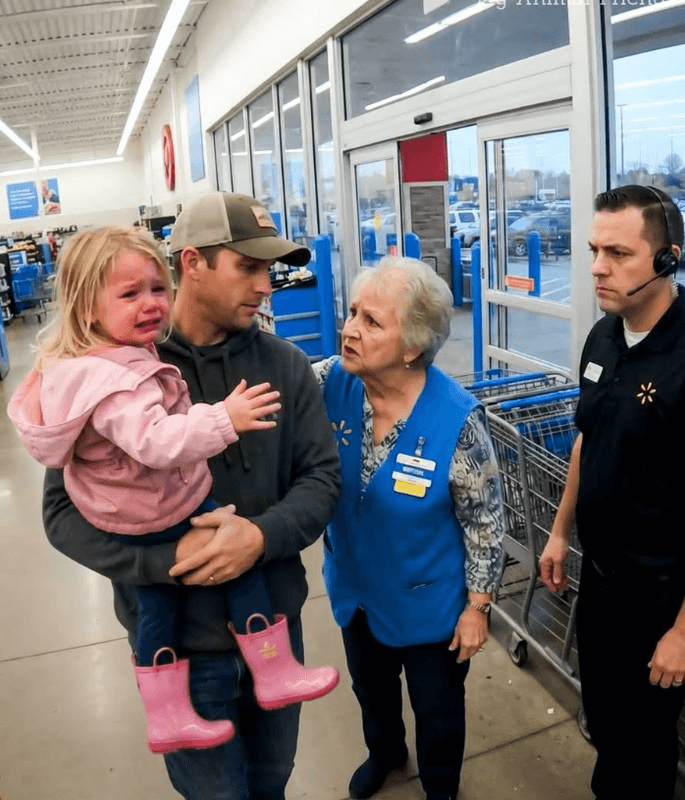
The first time I heard a three-year-old girl scream, “You're not my daddy!” I was standing beneath the automatic doors of a big-box store in Fort Smith, Arkansas, holding a sheet of smiley-face stickers.
I had heard children cry before.
I had heard them scream because their parents refused to buy them candy, because they had fallen down, or because they didn't want to leave the toy aisle.
But this was different.
There was terror in that little girl's voice.
And after thirty-one years delivering mail through neighborhoods where people didn't always answer their doors, I had learned something important.
Sometimes, the smallest warning is the one you cannot afford to ignore.
My name is Mavis Keller.
I was sixty-seven years old when everything changed.
For nine years, I had worked as a greeter at a large retail store on the edge of Fort Smith.
I wasn't there because I needed an exciting career.
I had retired from the United States Postal Service at sixty, after spending most of my adult life walking routes, carrying heavy bags, and learning the names of people who never bothered to learn mine.
My husband, Arthur, had died two years before I took the greeter job.
Our house had become painfully quiet.
I discovered that I missed having somewhere to go in the morning and people to talk to during the day.
So I put on a blue vest, stood near the entrance, and began saying hello.
It wasn't much.
But I liked it.
I kept a roll of smiley-face stickers in my vest pocket.
Every child who came through the doors received one.
Some children stuck them on their shirts.
Others put them on their mothers' purses.
One little boy used to save his stickers and bring them home to his grandmother.
Those small moments made the job worthwhile.
My manager, Darby Collins, used to joke that I was the store's cheapest customer-retention program.
I didn't mind.
I was happy doing something useful.
Then came that Tuesday afternoon in March.
It had been raining since lunchtime.
Customers were entering with wet umbrellas, dripping jackets, and shopping bags tucked beneath their arms.
At approximately 3:17 p.m., I noticed a man approaching the exit.
He was in his early forties.
He wore a charcoal-gray jacket, dark jeans, and expensive-looking leather shoes.
His hair was neatly combed.
He carried a little girl against his chest.
She was perhaps three years old.
She had curly brown hair, pink rain boots, and a yellow sweater with a tiny rabbit embroidered near the collar.
Her cheeks were wet.
Her arms were struggling.
And she was screaming.
“Put me down!”
The man adjusted his grip.
“Sweetheart, stop it.”
“I want my mommy!”
Several customers turned to look.
The man offered them an embarrassed smile.
“She skipped her nap.”
I watched the little girl's face.
She wasn't behaving like a tired child.
She was trying to get away from him.
I reached into my pocket and pulled out a smiley-face sticker.
“Hello, sweetheart.”
I kept my voice gentle.
“Would you like a sticker?”
The little girl suddenly turned toward me.
Her eyes widened.
Then she grabbed the front of my vest with both hands.
“Help me!”
The man stopped walking.
I felt the little girl's fingers tightening around the fabric.
“You're not my daddy!”
Her voice cracked.
“I want my mommy!”
The man's smile disappeared for half a second.
Then it returned.
“She's been difficult all afternoon.”
He shifted her higher against his chest.
“Come on, Quinn.”
The name caught my attention.
I looked at the girl.
“Is your name Quinn?”
She nodded rapidly.
Then she pointed at the man.
“He took me!”
The store seemed to become quieter.
I looked at the man.
“Sir, could you give me a moment?”
“Excuse me?”
“She seems frightened.”
“She is three years old.”
His voice hardened.
“Children have tantrums.”
“I understand.”
“Then move.”
He stepped toward the exit.
I moved with him.
Not aggressively.
I simply positioned myself between him and the automatic doors.
“May I ask her a question?”
The man's jaw tightened.
“You don't have any right to question me.”
“I only want to make sure she's all right.”
“She is my daughter.”
“What's her full name?”
He hesitated.
It was brief.
But I noticed.
“Quinn Haller.”
I looked at the child.
“Quinn, sweetheart, is this your daddy?”
She shook her head so violently that her curls bounced.
“No!”
Then she screamed something that made the hair rise along my arms.
“He took me from Miss Corliss's!”
The man went red.
“That's enough.”
He grabbed her more firmly.
I took a step forward.
“Sir, please don't frighten her.”
“Get out of my way.”
A woman standing near the checkout area pulled out her phone.
Another customer whispered something to her husband.
I knew I needed help.
I pressed the radio clipped to my vest.
“Could I get a manager to the front entrance?”
Darby arrived less than a minute later.
He was thirty-five, clean-shaven, and always dressed as if someone from corporate might be watching.
“What happened?”
The man immediately stepped toward him.
“Your employee is harassing me.”
He removed a driver's license from his wallet.
“This is my daughter.”
Darby examined the license.
Then the man opened his phone and showed him a photograph of himself holding a baby.
“There.”
He turned the screen toward Darby.
“That's me with her when she was six months old.”
Darby glanced at the photograph.
Then he looked at me.
“Mavis, what are you doing?”
“The child says he isn't her father.”
“She is three,” Darby replied.
“She also says he took her from someone named Miss Corliss.”
The man laughed sharply.
“Miss Corliss is her babysitter.”
I looked at him.
“Then why doesn't she want to go with you?”
“Because she's spoiled.”
Darby lowered his voice.
“Mavis, step aside.”
I stared at him.
“Please call the police.”
His expression changed.
“Don't make this bigger than it needs to be.”
“She is asking for help.”
“I said step aside.”
For nine years, I had followed store policy.
I had greeted customers, helped elderly shoppers find the pharmacy, and calmed children who had lost sight of their parents.
I had never been written up.
I had never received a customer complaint.
And now my manager was looking at me as if I were the problem.
The little girl was still clutching my vest.
“Please don't let him take me.”
I looked into her eyes.
I wanted to refuse.
I wanted to hold the door shut until the police arrived.
But Darby was my manager, and the man had produced identification.
I took one slow breath.
Then I stepped aside.
The man walked toward the parking lot.
Quinn continued crying.
As they passed through the automatic doors, she looked back at me.
“Help me!”
I followed them.
I didn't touch the man.
I didn't shout.
I didn't make any accusation.
I simply walked several yards behind them and pulled out my phone.
I took three photographs.
One of the man's face.
One of Quinn through the passenger-side window of a dark blue SUV.
And one of the license plate.
The man noticed me.
He rolled down his window.
“Are you photographing my child?”
I kept my distance.
“I called the police.”
His expression changed.
For one second, I saw something underneath his anger.
Fear.
Then he started the engine.
The SUV pulled out of the parking space and disappeared into the rain.
I called 911.
I gave the dispatcher the license plate, the vehicle description, and everything the little girl had said.
The dispatcher asked whether I had physically restrained the man.
“No.”
“Did you touch the child?”
“No. She grabbed my vest.”
“Did the man display identification?”
“Yes.”
“Did you see the child leave the parking lot?”
“Yes.”
The dispatcher told me officers would be sent to investigate.
I returned to the store.
Darby was waiting near the entrance.
He looked furious.
“You have just created a serious problem.”
“I called the police.”
“After you followed a customer into the parking lot?”
“He was carrying a child who was screaming that he had taken her.”
“You had no authority to interfere.”
“I didn't interfere.”
“You photographed a customer.”
“I photographed the vehicle and license plate.”
Darby shook his head.
“You should have stayed at your station.”
I wanted to tell him that a three-year-old girl had asked me to help her.
Instead, I went to the employee break room and sat down.
My hands were shaking.
That evening, I called the police station.
An officer confirmed that a report had been made.
He couldn't tell me whether anything had happened.
But he asked whether I would be willing to provide a written statement.
I said yes.
The next morning, Darby called me into his office.
A printed customer complaint lay on his desk.
The man's name was Wayne Haller.
He claimed I had grabbed his arm, threatened him, and publicly accused him of kidnapping his own daughter.
All three statements were false.
Darby folded his hands.
“Corporate doesn't want this kind of attention.”
“I never touched him.”
“That's not what he says.”
“I have photographs.”
He stared at me.
“Of what?”
“His face, his vehicle, and the license plate.”
He rubbed his forehead.
“Mavis, I am terminating your employment effective immediately.”
For a moment, I couldn't hear anything.
Nine years.
Nine years of being on time, being polite, and doing my job.
And I was being fired for refusing to ignore a frightened child.
I collected my handbag and the small photograph of Arthur I kept in my locker.
Before leaving, I removed the unused roll of smiley-face stickers from my vest.
I placed it on Darby's desk.
“Maybe the next person will need these.”
He said nothing.
Three weeks later, a thick envelope arrived at my house.
It came from a law firm in Little Rock.
Wayne Haller was suing me for $250,000.
The complaint accused me of assault, defamation, harassment, and intentional infliction of emotional distress.
His attorney claimed I had humiliated an innocent father in front of hundreds of customers.
I read the letter twice.
Then I sat at my kitchen table and cried.
I had never been sued in my life.
I couldn't afford a private attorney.
My retirement income covered the mortgage, utilities, groceries, and medication.
There wasn't an extra hundred dollars, let alone enough money to defend myself against a quarter-million-dollar lawsuit.
A legal aid organization eventually connected me with a young attorney named Ethan Brooks.
He was twenty-nine and looked like he hadn't slept properly in several weeks.
He listened to my account without interrupting.
Then he examined the photographs.
“Do you have the original files?”
“Yes.”
“Don't delete anything.”
He enlarged the photograph of the license plate.
“Did you receive any follow-up from the police?”
“Nothing beyond the report.”
He leaned back.
“Ms. Keller, I need you to understand something.”
“What?”
“Wayne Haller's lawsuit isn't necessarily the biggest problem in this case.”
I frowned.
“What do you mean?”
He tapped the photograph of Quinn.
“I'm concerned about what happened to this little girl after she left the store.”
I looked at the pink rain boots.
I had barely thought about anything else for three weeks.
“Do you think she was kidnapped?”
Ethan didn't answer immediately.
Instead, he opened the police report.
“There's something missing.”
“What?”
“The report lists the vehicle and your statement.”
He scrolled down.
“But it doesn't list a confirmed identity for the child.”
I stared at him.
“Didn't Wayne show them his driver's license?”
“Yes.”
Ethan turned the computer toward me.
“And here's something else.”
He pointed to the address listed for Wayne Haller.
It was in a town almost forty miles away.
“According to this complaint, Wayne says he lives with his daughter.”
I nodded.
“Then why is that important?”
“Because the same address appears in a different report.”
He opened another document.
I watched his face change.
“What report?”
He looked at me.
“A missing-child report filed eleven days before you saw Quinn.”
My hands went cold.
Ethan turned the monitor farther toward me.
The child's name was listed near the top.
QUINN WARD.
Age: Three.
Last known location: Corliss Family Childcare.
I read the name again.
Then I remembered what Quinn had screamed.
He took me from Miss Corliss's.
Ethan slowly closed the file.
“Mavis, I think we just discovered why Wayne Haller is so determined to make you look like a liar.”
And for the first time since the day I was fired, I understood something.
Wayne hadn't sued me because I embarrassed him.
He had sued me because I might be able to identify him.
And that meant someone else had been searching for the little girl long before I ever met her.