THE EIGHT WEEKS MY BROTHER ERASED
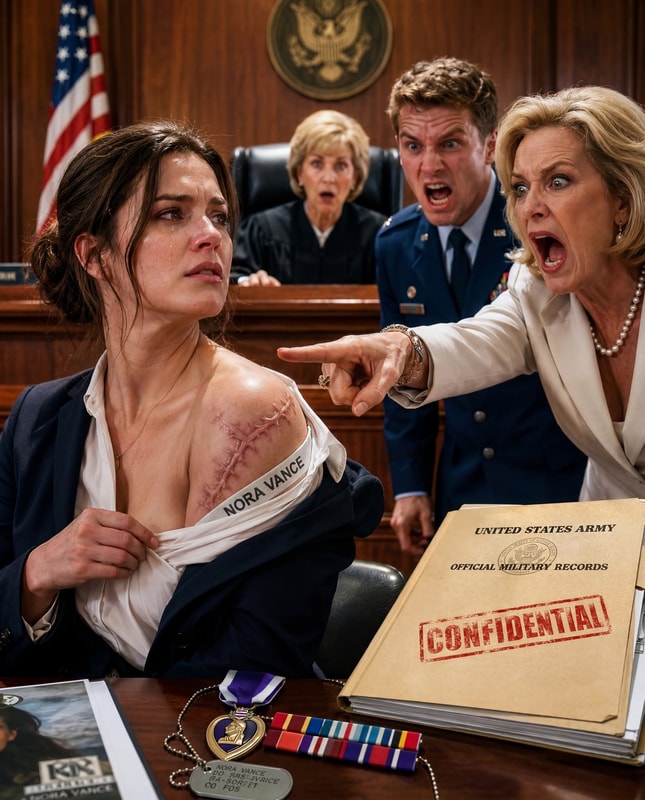
Derek Vance had always wanted the admiration that came with being a soldier.
He simply hadn't wanted the sacrifices.
When he enlisted at twenty-one, my mother treated the occasion like a royal ceremony.
She threw him a farewell party.
She ordered a cake decorated with an American flag.
She invited relatives who hadn't visited us in years.
And she told anyone who would listen that her son was going to become a military hero.
I attended the party while home on leave.
At the time, I had already served more than three years.
Nobody asked about my deployment.
Nobody mentioned the commendation I had recently received.
My mother spent the evening introducing Derek as the family's first real soldier.
I remember standing beside the kitchen counter when my aunt Linda approached me.
"Doesn't that bother you?"
I glanced toward the living room.
"Not anymore."
"But you're serving too."
"I know."
She touched my arm.
"Your grandfather knows."
That was enough for me.
Eight weeks later, Derek returned home.
There was no welcoming party.
No cake.
No explanations.
My mother told everyone he'd suffered a training injury.
She said the Army had mishandled his paperwork.
Derek claimed he had chosen to leave because the military wasn't what he'd expected.
I never questioned him.
I understood that military service wasn't for everyone.
Leaving training didn't make someone worthless.
But years later, when my mother accused me of inventing my military record, Derek suddenly began presenting himself as an authority on military procedures.
He claimed my awards were fake.
He called my medical records suspicious.
He told relatives that real veterans didn't discuss their injuries.
And he submitted a sworn declaration suggesting that my service history was impossible.
Daniel was the first person to notice the contradiction.
We were sitting in his office three weeks before the hearing.
The walls were lined with law books and framed photographs.
Rain struck the windows.
Daniel had spread my mother's filings across the conference table.
"Your brother describes himself as a former Army training specialist."
I looked up.
"That's ridiculous."
"Was he in the military?"
"Briefly."
"How briefly?"
"Eight weeks."
Daniel raised an eyebrow.
"Eight weeks?"
"He was discharged during basic training."
"Do you know why?"
"I heard different stories."
Daniel leaned back.
"Then we're going to need reliable records."
We couldn't simply obtain Derek's private personnel file because we were curious.
Daniel explained that records needed to be requested through lawful discovery and any appropriate authorization or court order.
Our first useful evidence came from Derek himself.
During a deposition, he claimed that he'd completed specialized training.
Daniel asked him to identify the installation.
Derek gave two different answers.
Then Daniel asked whether he possessed documentation supporting his credentials.
Derek said the Army had lost his records.
"All of them?" Daniel asked.
"That's what I said."
"Your discharge documentation too?"
Derek shifted in his chair.
"My mother handled that."
The deposition transcript became important later.
Not because Derek had failed basic training.
But because he had made specific claims while attempting to establish himself as an expert witness against me.
Then an unexpected development changed the investigation.
A former recruiter contacted Daniel.
His name was Robert Ellis.
He had known Derek during the enlistment process.
Ellis wasn't willing to discuss protected records without proper procedures.
But he said something that caught Daniel's attention.
"Derek has been using a military background to impress people for years."
Daniel asked whether Ellis would provide a statement concerning his firsthand knowledge.
He agreed.
His statement described Derek repeatedly exaggerating his qualifications during public events.
It also identified a veterans' fundraising organization where Derek had spoken as a supposed decorated service member.
That organization was called the Patriot Recovery Foundation.
I had never heard of it.
Daniel searched its publicly available filings.
Then he called me.
"Nora, I need you to come to the office."
"What's wrong?"
"Your brother's name appears on several foundation documents."
"So?"
"The foundation received donations for wounded veterans."
I waited.
"And your brother appears to have controlled some of those funds."
At first, I assumed it was another failed business venture.
Derek had started companies that sold fitness supplements, imported watches, and supposedly revolutionary agricultural equipment.
Every business ended with unpaid bills and a new excuse.
But Patriot Recovery was different.
Its website displayed photographs of wounded veterans.
It described housing assistance, emergency medical grants, and rehabilitation support.
One of the photographs showed a woman in Army medical clothing standing beside a military vehicle.
I recognized the image immediately.
It was me.
The photograph had been taken during my second deployment.
Part of my face was hidden by protective eyewear.
But the patch on my shoulder was visible.
My name appeared beneath the photograph.
"Sergeant Nora Vance, combat casualty survivor."
I stared at the screen.
"How did they get that?"
Daniel looked troubled.
"Do you remember signing a release?"
"No."
"Did your brother ever ask permission to use your story?"
"Never."
The foundation's promotional material described Derek as a military liaison.
It claimed that his sister's experience had inspired him to raise money for wounded service members.
But I had never received a dollar from the organization.
I hadn't known it existed.
Daniel requested financial records through discovery and issued appropriate subpoenas.
The results came slowly.
Some records were incomplete.
Some transactions lacked explanations.
But the pattern was unmistakable.
Donations had entered the foundation.
Money had then moved into accounts associated with Derek's businesses.
Several payments had been made to Westbridge Holdings.
The same development company that wanted Grandpa's farm.
I remember staring at the transaction summary.
"Why would a veterans' foundation pay a real estate developer?"
Daniel tapped the page.
"That's one of the questions we're asking."
Then he pointed to another line.
A transfer of $48,000 had been recorded with the notation "Vance property consultation."
The receiving account belonged to an entity Derek controlled.
I felt sick.
"Grandpa's money?"
"Possibly."
"How much is missing?"
"We don't know yet."
I pressed my fingers against my forehead.
The pain in my shoulder had started again.
It often appeared when I was under stress.
I could almost hear the explosion.
The sudden ringing.
The confusion.
The smell of burning metal.
I closed my eyes.
Daniel waited.
When I opened them, he spoke gently.
"You don't have to do this alone."
"I know."
But I wasn't thinking about the lawsuit anymore.
I was thinking about everyone who had donated money because they believed wounded veterans would receive help.
I was thinking about families who might have trusted Derek's promises.
And I was thinking about the photograph he'd stolen from my military past.
There was something particularly cruel about using my injuries to raise donations while simultaneously claiming those injuries were fake.
"Daniel."
"Yes?"
"I want every transaction examined."
"We'll pursue what the court allows."
"Not just the money involving Grandpa."
He studied me.
"Nora, that could become a separate investigation."
"Then it should."
Two days later, Daniel received a message from an accountant who had previously worked with Patriot Recovery.
Her name was Megan Price.
She said she'd left the organization after discovering irregular transfers.
She also said Derek had demanded that she destroy certain invoices.
Daniel arranged a meeting.
Megan arrived carrying a small cardboard box.
She was nervous.
She repeatedly looked toward the office door.
"I don't want my name made public unless it's necessary."
Daniel explained the limits of confidentiality and the possibility of testimony.
She listened carefully.
Then she opened the box.
Inside were copies of invoices, correspondence, and accounting notes.
One email caught my attention.
It had been sent by my mother.
The subject line read: "Nora's records."
The message was short.
"Use the Ohio payments to establish that she was never overseas. Once the court accepts that, the farm becomes available."
I read it twice.
Then a third time.
My mother hadn't simply believed Derek's lies.
She had helped construct them.
Megan watched my face.
"There's another email."
She handed Daniel a printed message.
This one came from Derek.
It contained only one sentence.
"Make sure nobody discovers where the original money came from."
Daniel looked at Megan.
"What original money?"
She swallowed.
"That's what I tried to find out."
"Did you find anything?"
Megan nodded slowly.
"An account belonging to Arthur Vance."
My grandfather.
I felt the room tilt.
"How long before he died?"
Megan looked down at her papers.
"Almost a year."
The theft hadn't started during Grandpa's final illness.
It had started long before.
And when Megan showed us the next document, I realized Derek had been using my grandfather's money to finance the very operation now accusing me of fraud.
But the most disturbing detail was written beside one of the transfers.
It was a name.
A name I recognized from my grandfather's brown envelope.
Charles Whitmore.