THE SECRET HIDDEN BENEATH MY BABY'S CLOTHES
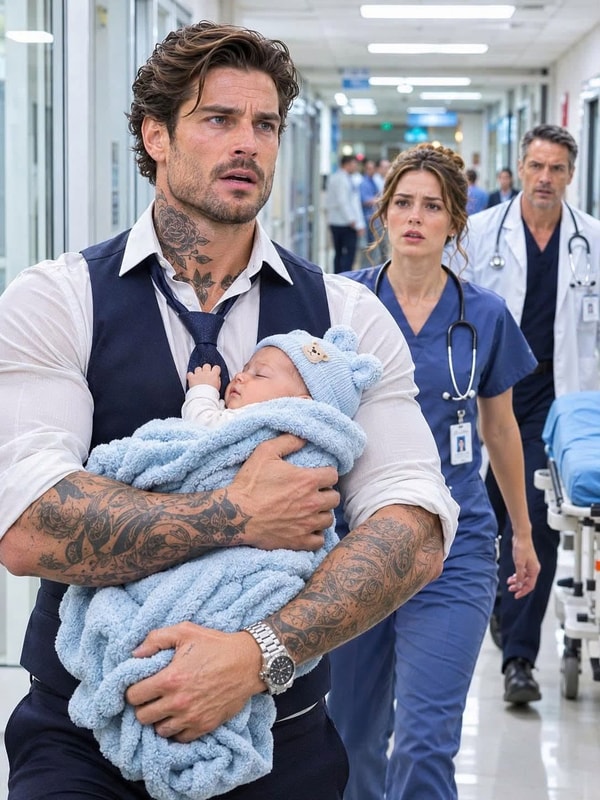
Dr. Hart led me into a small consultation room beside the pediatric intensive care unit.
There was a round table, three chairs, and a box of tissues positioned where grieving parents could reach them.
I noticed the tissues immediately.
That frightened me more than anything she had said.
"Mr. Bannister, Jonah's breathing became dangerously suppressed before he arrived here."
I gripped the edge of the table.
"Why?"
"We suspect he was exposed to a medication that was never prescribed for him."
"That isn't possible."
"Unfortunately, it is."
I shook my head.
"My son receives the best medical care available."
"Excellent medical care cannot protect a child from something administered outside a doctor's supervision."
Her words struck me like an accusation.
"Are you saying someone poisoned him?"
"I'm saying we need to determine what entered his system."
I sat down.
She continued carefully.
"During our examination, we found a small rectangular area of skin irritation beneath his left shoulder blade."
I remembered Tessa trying to explain something about Jonah's back.
Dr. Hart placed a photograph on the table.
The image showed a faint reddish outline on my son's delicate skin.
"That mark is consistent with prolonged contact from an adhesive medication patch."
I stared at it.
"Jonah doesn't use patches."
"That is why we're concerned."
She explained that certain prescription medications can be dangerous to infants, particularly when exposure affects breathing and alertness.
I could barely concentrate.
My thoughts kept returning to Tessa.
She had noticed something.
She had tried to tell me.
And I had silenced her.
"Did the housekeeper say anything about his back?"
My mouth felt dry.
"Yes."
"What did she say?"
"I didn't let her finish."
Dr. Hart studied my face.
"Then we need to speak with her."
I immediately called Marcus.
"Find Tessa Moreno."
"Sir?"
"The housekeeper I fired."
There was a pause.
"She left the property about forty minutes ago."
"Get her phone number."
"We have her employment file."
"Call her."
"I'll try."
I lowered the phone.
Dr. Hart watched me carefully.
"Mr. Bannister, has your son experienced unusual sleepiness or episodes of weakness recently?"
I thought about the previous two weeks.
Jonah had become quieter.
He smiled less.
Sometimes Doreen told me he had slept through most of the afternoon.
I had considered that a sign of excellent childcare.
Once, during breakfast, I had noticed him struggling to keep his eyes open.
Doreen said he was teething.
Another evening, he seemed unusually pale.
Doreen said he had missed his nap.
I remembered accepting every explanation because it was easier than questioning the person I had hired.
"He's been sleeping a lot," I admitted.
"How much?"
"I don't know."
"When was his last pediatric appointment?"
"Doreen manages his schedule."
"Do you know which medications or supplements he's receiving?"
I opened my mouth.
Then closed it.
I did not know.
I owned the house.
I paid the staff.
I signed the checks.
But I couldn't answer basic questions about my own son's daily care.
Dr. Hart waited without judgment.
That somehow made the shame worse.
"I need his medical records," she said.
"I'll get them."
"And I need the names of everyone who has been alone with him."
I nodded.
Then my phone rang.
Marcus.
"Sir, we reached Tessa."
"Where is she?"
"She's waiting at a bus terminal near downtown."
"Tell her to come to the hospital."
"She's already on her way."
I closed my eyes.
For a moment, I could hear my own voice echoing through the kitchen.
"I DON'T PAY YOU TO THINK!"
I had never hated the sound of my own words more.
An hour later, Tessa arrived at the hospital.
She was still wearing the faded blue blouse she had worn while cleaning my house.
Her hair was tied back.
Her eyes were red.
She had clearly been crying.
When she saw me standing outside the intensive care unit, she stopped walking.
"Mr. Bannister."
I approached her.
"Tessa."
She looked beyond me.
"Where's Jonah?"
"He's alive."
Her shoulders dropped.
"Thank God."
"But he's very sick."
She pressed a hand against her mouth.
Dr. Hart emerged from the consultation room.
"Are you Tessa Moreno?"
"Yes, ma'am."
"I'm Dr. Hart."
Tessa nodded.
Then, unexpectedly, the doctor looked at her with recognition.
"Tessa Moreno?"
Tessa's expression tightened.
"Yes."
"Did you work at Northbridge Children's Medical Center?"
A long silence followed.
"I did."
Dr. Hart stepped closer.
"You're the nurse who reported the medication discrepancies in the neonatal unit."
I looked between them.
"Nurse?"
Tessa lowered her gaze.
"I used to be."
The doctor frowned.
"I remember your case."
I stared at the woman I had employed to clean floors.
"You were a nurse?"
"Yes, sir."
"Why didn't you tell me?"
She met my eyes.
"Would you have listened?"
The question landed harder than any insult.
I had no answer.
Dr. Hart gently interrupted.
"Tessa, we need to discuss what happened this afternoon."
Tessa nodded.
"He was crying when I entered the nursery."
"What kind of crying?"
"Not his usual cry."
She took a breath.
"It was weak and uneven, and he kept drifting off even when I picked him up."
"Did you notice any breathing changes?"
"Yes."
"Anything else?"
Tessa hesitated.
"I smelled something strange on his clothes."
My pulse quickened.
"What kind of smell?"
"Medicinal."
She looked at me.
"I asked Doreen whether he'd been given something new, but she told me to mind my own business."
Dr. Hart leaned forward.
"Continue."
"After Doreen left, Jonah became more lethargic."
Tessa folded her hands together.
"I thought he might have overheated because he was wearing several layers despite the warm nursery."
"So you removed his clothes."
"Yes."
"And?"
Tessa's voice became unsteady.
"There was something stuck to his back."
Dr. Hart looked directly at her.
"What did you do with it?"
"I removed it because I was afraid it wasn't supposed to be there."
"Did you keep it?"
Tessa nodded.
"I didn't know what it was, so I put it in a little glass container and kept it away from Jonah."
My heart began pounding.
"Where is it?"
"In my bag."
She opened the worn handbag hanging from her shoulder.
Inside was a small glass container wrapped in a clean cloth.
Dr. Hart immediately called a nurse.
The container was taken for proper handling and examination.
Nobody spoke while the nurse left.
Then Tessa looked at me.
"I was trying to tell you."
I felt as though someone had emptied my chest.
"I know."
She shook her head.
"No, Mr. Bannister."
Her eyes filled.
"You don't know."
I swallowed.
"What do you mean?"
She looked toward the intensive care unit.
"That wasn't the first time I saw something unusual."
Dr. Hart pulled out a chair.
"Tessa, tell us everything."
Tessa sat down slowly.
"Three days ago, I was cleaning the upstairs hallway when I heard Doreen talking on the phone."
"What did she say?"
Tessa stared at her hands.
"She said the baby wasn't responding the way he was supposed to."
My stomach tightened.
"Responding to what?"
"I don't know."
She continued.
"Then she said someone would have to increase the pressure before Friday."
Dr. Hart and I exchanged a glance.
"Did you report that conversation?" the doctor asked.
"I tried to tell the household supervisor."
She looked ashamed.
"But he said Doreen had worked for important families for years, and I shouldn't interfere."
I knew exactly who she meant.
Martin Keene.
My chief of staff.
The man who had managed my personal affairs for nearly a decade.
Tessa wiped her eyes.
"Then this morning, Jonah was so sleepy that he barely reacted when I touched his feet."
She swallowed.
"I asked Doreen if he'd seen a doctor."
"And?"
"She said babies sleep."
My own words returned to me.
Babies cry.
Babies sleep.
Simple answers that allowed adults to ignore complicated dangers.
Dr. Hart asked another question.
"Tessa, did you ever administer medication to Jonah?"
"No."
"Did you give him anything by mouth?"
"No."
"Why the bath?"
"Because I'd removed the patch and needed to keep him comfortable while I checked his breathing."
Her voice cracked.
"I was frightened, and I was reaching for my phone when Mr. Bannister came in."
I felt physically ill.
I had mistaken her attempt to protect Jonah for disobedience.
Dr. Hart rested a hand on Tessa's shoulder.
"You did the right thing by noticing something was wrong and preserving what you found."
Tessa started crying.
Not loudly.
Not dramatically.
Just exhausted tears from someone who had been carrying a terrible fear alone.
I wanted to apologize.
Instead, I asked the question that had been tearing through my mind.
"Why didn't you call me?"
She looked up.
"I did."
I froze.
"What?"
"I called your office three times this morning."
My stomach dropped.
"Who answered?"
"Mr. Keene."
Martin.
Again.
"He said you were unavailable."
I took out my phone.
There were no missed calls from Tessa.
No messages.
Nothing.
Tessa reached into her bag.
"I also wrote down everything I noticed."
She handed me a folded piece of paper.
At the top were the words:
JONAH BANNISTER — POSSIBLE MEDICATION EXPOSURE — URGENT MEDICAL EVALUATION NEEDED.
Below them were dates, times, and observations.
I read each line.
My throat tightened.
She had been documenting my son's symptoms while the rest of us dismissed them.
I looked at the date beside the first entry.
It was seventeen days earlier.
Seventeen days.
For more than two weeks, someone had been putting my child in danger.
And the woman who noticed had been treated like a troublemaker.
Before I could speak, Dr. Hart's pager sounded.
She checked the message.
Her expression changed immediately.
"Excuse me."
She hurried toward the intensive care unit.
I followed.
"What happened?"
She stopped outside Jonah's room.
"His preliminary toxicology findings are consistent with exposure to a powerful prescription medication."
My vision blurred.
"Will he recover?"
"We're doing everything necessary to stabilize him."
Then she said something that made my entire body go cold.
"Mr. Bannister, this may not have been a single exposure."
I stared at her.
"What does that mean?"
"It means someone may have been putting your son at risk repeatedly."
Behind the glass, I saw Jonah lying motionless beneath a hospital blanket.
Machines monitored every breath.
And for the first time, I understood that someone inside my own home might have been trying to kill him.