THE MAN WHO WANTED THE HOUSE GONE
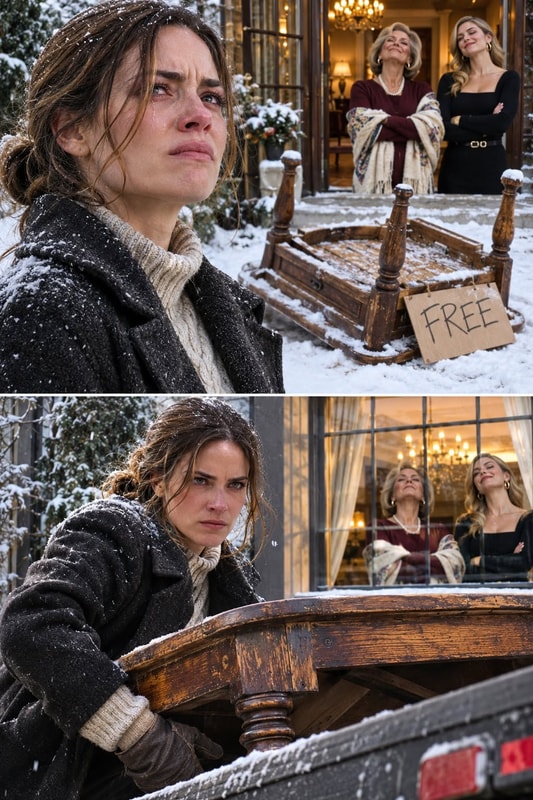
Three days after Thanksgiving, Gideon Pike walked into my furniture workshop without an appointment.
I was repairing the damaged corner of Grandma's table when the front bell rang.
At first, I assumed it was a customer.
Then I saw the polished black shoes beside my workbench.
"Claire Mercer."
Gideon's voice was smooth and controlled.
"I've heard a great deal about you."
I put down my clamp.
"Then you know this isn't a good time."
He smiled.
"On the contrary."
He looked around the workshop.
Antique chairs stood along one wall.
A partially restored cherry cabinet occupied the center.
Grandma's table rested beneath a soft protective sheet.
Gideon walked toward it.
"Beautiful work."
"Don't touch it."
He stopped.
His smile narrowed.
"I admire craftsmanship."
"Then you should understand why people protect it."
He glanced at me.
"I understand that objects can become emotionally complicated."
I folded my arms.
"What do you want?"
"To clear up a misunderstanding."
"There isn't one."
He removed a leather folder from beneath his arm.
"Your sister has entered into a perfectly legitimate business arrangement."
"One that requires demolishing a protected house."
"That protection is disputed."
"By you."
He smiled again.
"Legal matters are rarely as simple as they appear."
I thought about Grandma's forged signature.
"Especially when documents appear that dead people couldn't have signed."
For the first time, Gideon stopped smiling.
He studied me carefully.
"That's a serious allegation."
"So is forging a legal release."
He opened his folder.
Inside was a printed proposal.
At the top, someone had placed my name.
The document offered me seventy-five thousand dollars in exchange for signing a broad agreement not to interfere with the redevelopment project and withdrawing any objections I had submitted.
I stared at the amount.
"You're offering me money to stop asking questions."
"I'm offering compensation for your cooperation."
"You don't need my cooperation if everything is legitimate."
His jaw tightened.
"Miss Mercer, your sister is about to become a very wealthy woman."
"And Grandma's house is about to become rubble."
"That property is underused."
"It was her home."
"It's a house."
I looked toward the table.
"No."
My voice remained steady.
"It was a home."
He placed a pen beside the proposal.
"Seventy-five thousand dollars could expand this workshop considerably."
I thought about the loan I was still paying on the building.
I thought about the orders I had turned down because I couldn't afford another employee.
I thought about how easy it would be to convince myself that Grandma was gone and the house was only wood and plaster.
Then I remembered her standing beside the fireplace with flour on her cheek.
I pushed the folder back toward him.
"No."
Gideon watched my hand.
"You haven't considered the offer."
"I have."
"People usually negotiate."
"I'm not negotiating."
His expression became colder.
"Your mother understands the value of moving forward."
"My mother doesn't speak for me."
He gathered the papers.
"Family disputes can become costly."
"Then stop creating them."
He looked toward the covered table one final time.
"Your grandmother was a difficult woman."
Something inside me snapped.
"Get out."
He adjusted his coat.
"I hope you reconsider."
I opened the door.
"I won't."
He stepped outside.
Then he turned.
"One piece of advice, Claire."
I waited.
"Be careful about making promises on behalf of people who can no longer explain their decisions."
He walked away before I could respond.
I stood in the doorway watching his SUV disappear.
The conversation left me shaken.
Not because of the money.
Because of the way he spoke about Grandma.
He hadn't sounded like a developer frustrated by a zoning obstacle.
He had sounded like someone who had spent years waiting for her to die.
That afternoon, I visited Grandma's former neighbor, Mrs. Ruth Ellison.
Ruth was eighty-one and had lived beside the Bell House for nearly fifty years.
She answered the door wearing slippers and a faded cardigan.
"Claire!"
She pulled me into a hug.
"I heard about the table."
My throat tightened.
"Everybody seems to have heard."
Ruth led me into her kitchen.
A kettle whistled softly on the stove.
She poured tea into two mismatched cups and sat across from me.
"Your grandmother would have had a few words for Vanessa."
I managed a small smile.
"Probably."
Ruth shook her head.
"That girl never knew the difference between old and worthless."
I showed her the developer's map.
She studied it with a deepening frown.
"Gideon Pike."
"You know him?"
"I knew his father."
She set down the paper.
"And I remember when that family first tried to buy Eleanor's property."
"When?"
"Years ago."
Ruth looked toward the window.
"Before your father disappeared."
I went still.
My father, Robert Mercer, had vanished in May 2004.
His truck had gone through a guardrail near Hollow Bridge during a night of heavy rain.
Search crews found the vehicle in the river.
They never recovered his body.
After years of legal proceedings, he had been declared dead.
I was fifteen when it happened.
Vanessa was twelve.
Our mother told us he had been driving too fast after an argument.
She never wanted to discuss it.
Grandma rarely spoke about that night either.
But every year on the anniversary, she sat alone at the oak table until midnight.
"What does my father have to do with Pike?" I asked.
Ruth's fingers tightened around her teacup.
"Robert worked as a surveyor for the county."
"I know."
"He was looking into something along the river."
"What?"
"I never knew the details."
She hesitated.
"But I remember him coming to see your grandmother several days before the accident."
"That doesn't sound unusual."
"It wasn't unusual for him to visit."
Ruth leaned forward.
"What was unusual was how frightened he looked."
I felt cold.
"Frightened of what?"
"He asked Eleanor to keep some papers safe."
"What papers?"
"I don't know."
She looked toward the door.
"Your grandmother sent me home before they talked."
I stared at her.
"Why didn't you tell me this before?"
Ruth's eyes filled with regret.
"Your mother made it very clear that the family needed peace."
I almost laughed.
Peace.
The word had been used to silence me since childhood.
Ruth reached across the table.
"Claire, there is something else."
I waited.
"The night your father's truck went into the river, I saw a black car parked outside your grandmother's house."
My heart began pounding.
"Who was inside?"
"I couldn't see."
"Was Grandma home?"
"Yes."
Ruth swallowed.
"And someone was arguing with her."
"Who?"
"A man."
She shook her head.
"I never saw his face."
I left Ruth's house with more questions than answers.
At home, I opened my father's old photograph album.
Most pictures showed him smiling beside Vanessa and me.
He was broad-shouldered, dark-haired, and always seemed slightly uncomfortable in formal clothes.
In one photograph, he stood beside Grandma's fireplace holding a measuring tape.
I looked closer.
On the mantel behind him sat a small blue metal box.
I had never noticed it before.
I enlarged the photograph on my phone.
The box appeared to have a white label.
The writing was too blurry to read.
I immediately called Ada.
"Did anyone document a blue metal box near Grandma's fireplace?"
Ada asked me to email the photograph.
Ten minutes later, she called back.
"I've seen something like this."
"Where?"
"In an old inventory your grandmother prepared."
My pulse quickened.
"What did the inventory say?"
"That certain records were held in a sealed metal container."
"Where is it now?"
"We don't have it."
She hesitated.
"Your grandmother wrote that it was to remain with the property."
I closed my eyes.
"Vanessa threw out the mantel."
"I know."
"Then the box might have gone with it."
Ada spoke carefully.
"Claire, we filed a formal notice today."
"Against Vanessa?"
"Against the property owner and the responsible parties."
"What happens next?"
"We're requesting an inspection."
I glanced at the photograph again.
"Can they refuse?"
"They can challenge our request, but the recorded agreement gives us inspection rights."
That night, I returned to the online planning records.
A new document had appeared.
It was an updated project schedule from Pike Development.
The company intended to begin demolition preparation in January.
Their proposed budget exceeded eighteen million dollars.
Near the bottom of the page, one figure stood out.
Land acquisition allowance: $2,400,000.
I stared at the number.
Mom had given Vanessa the house for one dollar.
Vanessa planned to sell it for millions.
I suddenly understood why my sister had been so desperate to clear the old rooms.
She wasn't decorating a family home.
She was preparing inventory for a sale.
My phone rang.
Mom.
This time, I answered.
"Claire."
Her voice was exhausted.
"Please tell me you haven't hired a lawyer."
I looked at the redevelopment proposal.
"Why did you give Vanessa the house?"
"Because she needed a fresh start."
"Did Gideon Pike promise you money?"
Silence.
"Mom?"
"That's none of your business."
"It becomes my business when someone uses Grandma's signature on a questionable document."
Her breathing changed.
"What document?"
"The release of the preservation agreement."
She didn't respond.
"Did you know about it?"
"Claire, stop."
"Did you?"
Her voice cracked.
"You don't understand what people are capable of when money is involved."
I felt my stomach drop.
"Then explain it."
For several seconds, all I heard was her breathing.
Finally, she whispered something I would remember for the rest of my life.
"Your grandmother should have sold that house twenty years ago."
Then she hung up.
I sat alone in the workshop for a long time.
The old oak table stood beneath its protective covering.
I remembered how Grandma used to run her fingers along the worn edge whenever she was worried.
Almost without thinking, I reached beneath the table and touched the old wooden crosspiece.
My fingertips encountered a small irregularity.
A shallow carved mark.
I turned on my work lamp.
Beneath the central support, hidden behind a darkened patch of wood, someone had carved two letters.
R.M.
My father's initials.
And beneath them was a date.
MAY 8, 2004.
The day before his truck went into the river.