THE PROMISE MY GRANDMOTHER KEPT
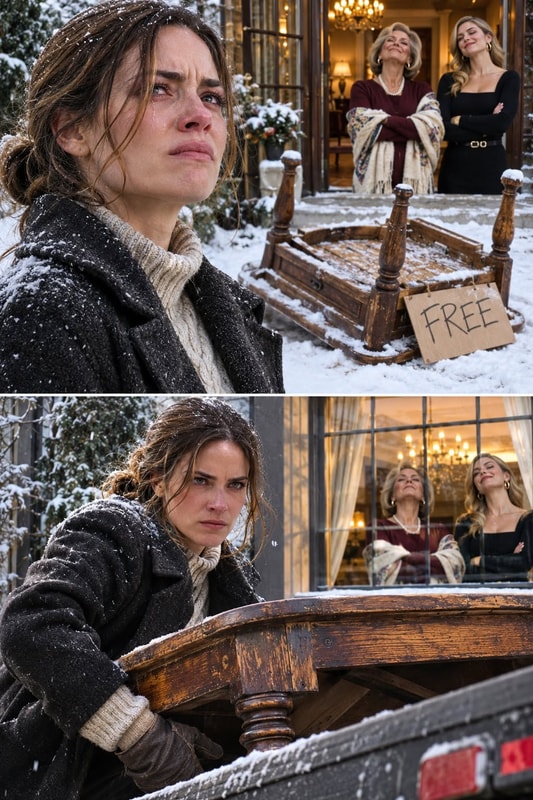
By January, the Bell House had become the center of a dispute none of us could escape.
The preservation injunction remained in place.
The fire investigation continued.
Gideon Pike had stopped answering questions from reporters.
And my mother had moved into a small apartment after doctors released her from the hospital.
Vanessa stayed away from the damaged house.
She also stopped speaking to Gideon.
For the first time in our adult lives, my sister and I were fighting the same battle.
That didn't mean everything between us was forgiven.
It meant the truth had become more important than our arguments.
I still remembered her laughter on Thanksgiving.
I still remembered Grandma's table upside down in the snow.
Some wounds didn't disappear because someone finally admitted they were wrong.
One Saturday morning, Vanessa arrived with a cardboard box.
"I found these in Mom's garage."
Inside were old photographs, school records, and several folders that had belonged to Dad.
I lifted a small photograph from the top.
It showed Vanessa and me sitting beneath Grandma's table during a thunderstorm.
I was twelve.
Vanessa was nine.
Dad sat beside us with a flashlight under his chin, telling ridiculous ghost stories while Grandma pretended not to listen.
For a moment, I could almost hear him laughing.
Vanessa sat down.
"I forgot about that night."
I smiled sadly.
"Grandma made hot chocolate."
"And Dad told us the refrigerator was haunted."
We both laughed.
Then Vanessa began crying.
"I'm sorry, Claire."
I looked at her.
"I know."
"No."
She shook her head.
"I'm sorry about the table."
Her voice broke.
"I knew how much it meant to you."
I waited.
"I put it outside because I wanted you to see that the house was mine."
The honesty hurt.
"Why?"
"Because I thought you had always gotten the part of Grandma that mattered."
I stared at the photographs.
"Vanessa, she loved you."
"She did."
My sister wiped her cheeks.
"But I was too busy comparing everything to notice."
I didn't know whether I could forgive her yet.
But for the first time, I believed she understood what she had done.
We spent the afternoon sorting Dad's papers.
Most contained ordinary records.
Old pay stubs.
Car maintenance receipts.
Birthday cards.
Receipts for school supplies.
Then Vanessa found a notebook with a dark green cover.
The first pages contained measurements and sketches.
Farther inside, Dad had written about Bell Creek.
One entry was dated March 2004.
"Original culvert alignment does not match revised county plat."
Another entry mentioned unrecorded fill material along the northern boundary.
A third contained a name.
Arthur Pike.
Gideon's father.
Dad had underlined it twice.
I photographed every page.
Then I called Helena.
She arranged a meeting with an environmental attorney who specialized in land-use disputes.
His name was Samuel Greer.
He examined the maps and notebook without making promises.
"These documents are interesting," he said.
"But we'll need independent verification."
I nodded.
"Can we get it?"
"Possibly."
He pointed to Dad's survey marks.
"If the old boundary markers still exist, a licensed surveyor may be able to compare them with current records."
"And the culvert?"
"That requires a separate investigation."
He leaned back.
"We should also determine whether there are environmental records related to the site."
I looked at the map.
"What if someone buried something there?"
Samuel didn't speculate.
Instead, he said, "Then any investigation needs to be lawful, controlled, and properly documented."
It was the first time someone had spoken about the mystery without treating it like a family argument.
The implications were bigger than Grandma's house.
The old creek connected to land owned by several families.
If Dad's concerns were legitimate, the records might affect far more people than us.
Several days later, Ada called with another discovery.
The preservation Trust had located correspondence from Grandma dating back to 2012.
She invited me to read it.
I arrived before the office opened.
Ada placed a thick folder on the conference table.
The first letter was from Grandma.
"I am requesting protection for the original dining room, fireplace mantel, eastern windows, and northern stone wall."
Her handwriting was steady.
The next paragraph explained her reasons.
"The house contains historic features that have survived generations of change."
Then came a sentence that made me stop.
"Some people believe the value of a place begins when they can erase everything that came before them."
I swallowed.
Grandma had known exactly what kind of people she was dealing with.
A second letter was dated three months later.
It described repeated offers to purchase the property.
Grandma refused because the proposed development would require significant demolition and alteration.
Then I found a short handwritten note attached to the correspondence.
"Robert believed there was something wrong with the creek surveys."
My pulse quickened.
"He was trying to bring the matter to the proper authorities."
I continued reading.
"After he disappeared, I kept copies of what he left with me."
The next sentence was underlined.
"I cannot prove what happened to him, but I will not let anyone pretend his concerns never existed."
I pressed my fingers against the page.
Grandma had been fighting for him all those years.
I remembered every Christmas when she sat quietly beside the fireplace after dinner.
Every anniversary when she looked toward the river.
Every time she told me never to confuse silence with peace.
Now I understood.
She hadn't been protecting a mystery because she enjoyed secrets.
She had been protecting the few records she still possessed.
Ada handed me a tissue.
"Your grandmother wanted the house preserved."
I nodded.
"But she also wanted someone to keep asking questions."
Ada's eyes softened.
"Yes."
That evening, I visited Mom.
Her apartment was small, with cream walls and furniture that looked borrowed.
She sat near the window holding a cup of tea.
For several minutes, neither of us spoke.
Then I placed Dad's notebook on the coffee table.
Mom stared at it.
"Where did you find that?"
"Vanessa brought it."
She closed her eyes.
I sat across from her.
"Mom, what happened in 2004?"
She began trembling.
I waited.
Finally, she said, "Your father was investigating something he shouldn't have touched."
"According to whom?"
"People who had money."
I felt anger rise.
"Did someone threaten him?"
Mom nodded slowly.
"He started receiving calls."
"From Gideon's family?"
She looked away.
"Mom."
Her eyes filled.
"Arthur Pike came to our house."
"When?"
"Three days before Robert disappeared."
I gripped the edge of the chair.
"What did he want?"
"He said your father was making accusations that could destroy businesses and cost people their jobs."
"And?"
"He offered money."
My stomach tightened.
"To make Dad stop?"
"Yes."
"Did Dad take it?"
"No."
She shook her head fiercely.
"Your father refused."
I swallowed.
"Then what happened?"
Mom covered her face.
"I was frightened."
"Of Arthur Pike?"
"Of losing everything."
Her voice broke.
"We had debts you didn't know about."
I waited.
"Arthur said he could make the problems disappear."
I stared at her.
"What did you sign?"
She looked at me with the exhausted expression of someone who had been holding a terrible secret for too long.
"A statement."
"What kind of statement?"
"He wanted me to say Robert had become unstable."
I felt sick.
"Did you?"
Mom began crying.
"Yes."
I stood.
I couldn't sit still.
"You told people Dad was unstable?"
"I was scared."
"Did you know it wasn't true?"
She didn't answer.
That was answer enough.
I walked toward the window.
For years, I had believed Dad's disappearance was linked to some private failure.
Mom had allowed that belief to grow.
Now I knew she had helped create it.
Behind me, she whispered, "I never wanted you girls to hate him."
I turned.
"Then why did you let us believe he abandoned us?"
Her face crumpled.
"Because I thought if I kept quiet, they'd leave us alone."
I shook my head.
"Who?"
She looked toward the door.
"The people who wanted that land."
I sat down again.
"Why did you give the house to Vanessa?"
Mom wiped her eyes.
"Gideon told me the old problems were finally over."
"Did you believe him?"
"I wanted to."
Her voice became smaller.
"He said Vanessa could sell the property and we could all start over."
I stared at her.
"After everything Grandma did to protect it?"
Mom lowered her head.
"I told myself the past was already gone."
The room fell silent.
Then I asked the question I had been afraid to ask.
"Do you believe Dad died that night?"
Mom stopped moving.
Her eyes lifted toward mine.
For several seconds, she didn't speak.
Finally, she whispered, "I don't know."
I felt the words move through me like cold water.
"What do you mean, you don't know?"
"They never found him."
"I know that."
She began crying again.
"And your grandmother never believed the whole story."
I leaned forward.
"What story?"
Mom stared at the old notebook.
"That Robert was alone when he went over the bridge."
Before I could ask anything else, there was a knock at the apartment door.
Mom flinched.
I stood and looked through the peephole.
A uniformed police officer stood outside.
He identified himself as Detective Nathan Rios.
When I opened the door, his expression was serious.
"Miss Mercer."
I stepped aside.
"What's happened?"
He looked toward Mom.
"I need to ask Diane some questions."
My mother slowly rose from her chair.
Nathan continued.
"We've obtained additional evidence concerning the fire at the Bell House."
I felt my stomach tighten.
"What evidence?"
He glanced at me.
"A security recording."
"From the night of the fire?"
"Yes."
He turned toward my mother.
"Mrs. Mercer, the recording appears to show you speaking with a man outside the house before the fire began."
Mom turned pale.
Nathan paused.
"And we need to understand why that man entered the property carrying the blue metal box."