THE TABLE THEY LEFT TO DIE IN THE SNOW
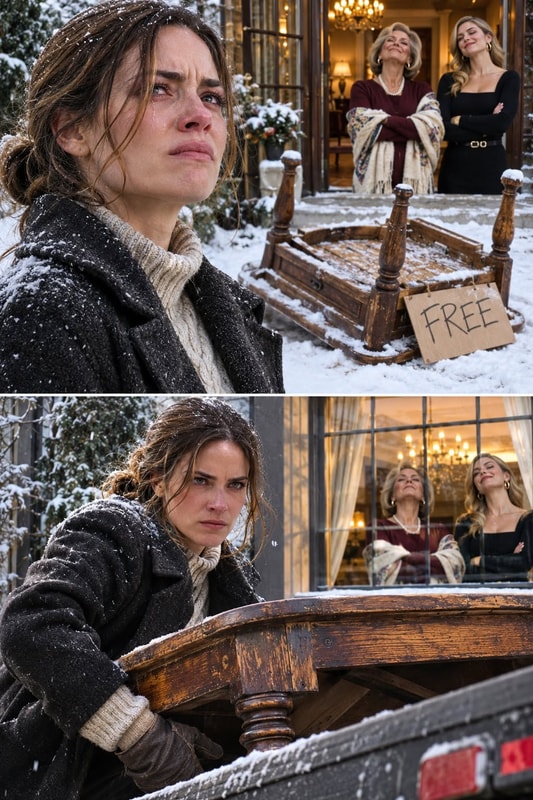
The first thing I saw when I pulled into Grandma's driveway on Thanksgiving was her dining room table lying upside down in the snow.
The second thing I saw was the cardboard sign taped across its underside.
FREE.
For a moment, I couldn't understand what I was looking at.
The enormous oak table had stood in that house for more than seventy years, surviving births, funerals, Christmas mornings, and every difficult conversation our family had ever refused to finish.
Now its four legs pointed toward a gray November sky like the stiff limbs of something left to die.
Snow gathered inside the carved grooves along its edges.
A dirty tire track crossed one corner.
Someone had dragged it across the gravel driveway, leaving a long scratch through the finish I had spent six months restoring.
I was holding a homemade apple pie when I stepped out of my car.
By the time I reached the curb, my hands were shaking so badly that the pie tin rattled against its foil covering.
I knew every inch of that table.
I knew the small crescent-shaped burn beside the head chair where Grandpa had accidentally set down a hot coffee pot in 1968.
I knew the shallow indentation near the center where Grandma had rolled pie dough every Thanksgiving.
I knew the darker patch along the eastern edge where her right hand had rested while she listened to everyone else's stories.
Those marks weren't damage.
They were the fingerprints of a life.
And I had protected every one of them when I restored the table after her funeral.
My name is Claire Mercer.
I was thirty-seven years old, and until that Thanksgiving afternoon, I believed there were certain things even my family wouldn't destroy.
I was wrong.
Grandma Eleanor Bell had died the previous February at ninety-three.
For most of my childhood, her house in Millhaven, New York, had been the only place where I felt completely safe.
My parents fought about money.
My younger sister, Vanessa, always wanted whatever someone else possessed.
But Grandma never measured a person's worth by the size of their house or the price of their clothes.
She measured people by whether they stayed when someone needed help.
When I was twelve, I accidentally spilled an entire bowl of cranberry sauce across her table.
I cried because I thought I had ruined it.
Grandma laughed, handed me a towel, and said something I never forgot.
"Sweetheart, furniture can survive a mess."
Then she touched my cheek.
"People are what we have to be careful with."
After she died, her attorney handed me a small envelope containing a handwritten list of personal belongings.
My name appeared beside exactly one item.
The 1919 oak dining table.
Grandma had underlined the words twice.
She left the house to my mother, Diane Mercer, who was her only surviving daughter.
She left most of her savings to a small local historical foundation.
And she left the table to me.
I spent six months repairing loose joints, stabilizing a cracked leg, and removing decades of inappropriate varnish without disturbing the marks that mattered.
I worked on it in Grandma's dining room because my mother said she didn't mind keeping it there until I found enough space in my workshop.
Vanessa made jokes about my obsession.
Mom called it a sentimental waste of time.
But Grandma had once told me that her father built the table in 1919 using white oak from a tree that fell during a storm.
He had been twenty-seven years old.
He was newly married, nearly broke, and determined to build something his children could inherit.
More than a century later, I was watching his work freeze beside a garbage can.
I left the pie in my car and walked toward the front door.
Through the large dining room windows, I could see champagne glasses, expensive decorations, and relatives gathered around a gleaming marble island.
The original dining room wall was gone.
The fireplace looked ***** without its hand-carved mantel.
And the oak table was nowhere inside.
I opened the door without knocking.
Laughter drifted toward me.
My sister stood beneath a crystal chandelier, wearing a cream-colored sweater dress and holding a glass of champagne.
Our mother stood beside her, proudly showing photographs of the renovation to our aunt Patricia.
Vanessa noticed me first.
"Claire!"
She smiled with the exaggerated sweetness she used whenever she wanted an audience.
"You're late."
I ignored her.
"Why is Grandma's table outside?"
The room grew quieter.
Mom glanced toward the window.
"Oh, that thing."
She waved dismissively.
"Vanessa needed the dining room cleared before the guests arrived."
I stared at her.
"You put it on the curb?"
Vanessa laughed.
"Don't sound so dramatic."
I looked directly at my sister.
"That table belongs to me."
She raised one carefully shaped eyebrow.
"Then congratulations."
She gestured toward the front yard.
"Your property is waiting for you."
Someone chuckled.
I felt my face grow hot.
"Did you seriously put a FREE sign on it?"
Mom sighed.
"Claire, please don't ruin Thanksgiving."
"Grandma left that table to me."
"And Grandma left this house to me," Mom snapped.
"I gave it to Vanessa, and Vanessa can decorate it however she wants."
That part was true.
In August, Mom had transferred Grandma's house to Vanessa for one dollar.
I hadn't argued.
I knew the house belonged to Mom under Grandma's will, and I had no desire to fight over an inheritance.
But the table was different.
Vanessa lifted her champagne glass.
"Mom finally gave this house to someone who could make it beautiful."
She looked around at the white walls and polished floors.
"Look at this place."
I looked.
The old pine floors had disappeared beneath glossy gray tile.
The photographs Grandma kept on the mantel were gone.
The doorway where she used to measure our height had been widened.
Every room looked expensive.
Nothing looked loved.
"Where's the mantel?" I asked.
Vanessa made a face.
"Please tell me you're not emotionally attached to that ugly thing too."
My stomach tightened.
"What did you do with it?"
"We removed it."
"Where is it?"
"Probably in a dumpster somewhere."
I turned toward Mom.
"You let her tear out Grandma's fireplace mantel?"
Mom crossed her arms.
"That old table was trash, Claire."
Then she pointed toward the renovated room.
"Vanessa needs space for things that actually have value."
My sister smiled.
"You can't build a beautiful house around dead people's furniture."
The words landed harder than I expected.
I remembered Grandma sitting at that table during her final Christmas, too weak to stand but determined to serve everyone herself.
I remembered how Vanessa had spent the afternoon complaining that the house smelled old.
I remembered Grandma quietly asking me to stay after dinner.
"Don't let them make you ashamed of caring," she'd whispered.
At the time, I thought she meant Vanessa's insults.
Now I wasn't so sure.
I looked at my mother.
"You put my property in the snow."
Vanessa shrugged.
"Then call the police."
She smiled at the room.
"Maybe they'll arrest the weather."
Several relatives laughed.
My cousin looked uncomfortable but said nothing.
Mom turned away as if the conversation were finished.
I stood there feeling something inside me become very still.
I could have screamed.
I could have knocked Vanessa's champagne glass out of her hand.
I could have reminded everyone how many nights I spent caring for Grandma while they were too busy to visit.
Instead, I placed my purse on the counter.
"All right."
Vanessa blinked.
"All right what?"
"If the table is trash, I'll take it out for you."
She smiled.
"Finally."
Then she turned to our aunt.
"Something useful."
I walked outside.
My friend Owen Brooks answered his phone on the third ring.
Owen owned a small moving company and had known me since high school.
He listened without interrupting while I explained what happened.
Then he asked one question.
"Is the table still outside?"
"Yes."
"I'm bringing the flatbed."
Forty minutes later, Owen pulled into Grandma's driveway.
He climbed out, looked at the table, and stopped.
"Good Lord, Claire."
I swallowed.
"I know."
He carefully lifted one of the exposed legs.
The wood had begun absorbing moisture where the finish was damaged.
A joint I had repaired in June was splitting again.
Owen removed his gloves.
"Let's get her home."
We wrapped the table in thick moving blankets, secured the legs, and lifted it onto the truck.
Nobody came outside to help.
Through the dining room window, I watched my mother laughing beside Vanessa's new marble island.
My relatives were eating the Thanksgiving dinner Grandma used to prepare.
And I was loading the one thing she had trusted me to protect.
Before we left, I looked toward the front windows.
Something about the missing mantel bothered me more than I could explain.
Grandma had always been strangely protective of that fireplace.
Whenever contractors suggested updating it, she refused.
Once, when I asked why, she told me the mantel was part of the house's promise.
I had laughed.
"What promise?"
She had looked at me for a long moment.
"One you'll understand when you need to."
That night, Owen helped me carry the table into my workshop.
I turned on the overhead lights and began photographing every scratch.
Snowmelt dripped from the legs onto the concrete floor.
One corner had suffered a deep gouge.
A section of molding was cracked.
The damage wasn't impossible to repair, but the humiliation felt permanent.
Owen watched me peel the FREE sign from the underside.
"You okay?"
I shook my head.
"I don't think so."
He leaned against the workbench.
"Your grandma loved that table."
"I know."
"And she knew you'd take care of it."
I looked at the damp oak.
"Then why does it feel like I failed her?"
He didn't answer immediately.
Finally, he said something that made me cry.
"Because you're the only person in that house who understood what they threw away."
After Owen left, I opened the small metal filing cabinet beside my desk.
Inside was the envelope Grandma's attorney had given me after her funeral.
I had read her handwritten list dozens of times.
But that night, I unfolded every page.
Beneath the list was a document I had barely examined before.
Its title was printed in bold capital letters.
HISTORIC PRESERVATION EASEMENT AGREEMENT.
My grandmother had signed it in 2012.
It named the Hudson Valley Preservation Trust as the organization responsible for enforcing the agreement.
The document protected specific original architectural features of the Bell House.
The dining room footprint.
The hand-carved fireplace mantel.
The original east-facing windows.
And the stone retaining wall along the northern edge of the property.
I read the restrictions three times.
Any substantial alteration required written approval from the Trust.
No such approval appeared in Grandma's papers.
I thought about the missing wall.
The marble island.
The fireplace stripped down to bare plaster.
Then I noticed a handwritten note beneath Grandma's signature.
It was addressed to me.
"Claire, if they ever remove the mantel, do not let them throw away what was hidden behind it."
My breath caught.
There was another sentence.
"The people who want this house will tell you that everything inside it is worthless."
And one final line.
"Before you believe them, ask why they need the old things gone."
I sat down hard on my workshop stool.
Outside, snow struck the windows.
Inside, the antique clock Grandma had given me ticked steadily beside the damaged table.
I reached for my phone and searched for the preservation foundation's emergency contact.
Someone answered after several rings.
"Hudson Valley Preservation Trust."
"My name is Claire Mercer."
I stared at the handwritten warning.
"I think someone has illegally altered a protected historic property."
The woman on the line became very quiet.
"Which property?"
"The Eleanor Bell House in Millhaven."
There was a pause.
Then I heard papers moving.
"Miss Mercer, are you alone?"
The question startled me.
"Yes."
"Have they removed the dining room mantel?"
I looked toward the workshop door.
"Yes."
The woman inhaled sharply.
"Then please don't go back to that property tonight."
I gripped the phone.
"Why?"
Her answer turned my blood cold.
"Because your grandmother warned us someone might eventually try this."
And before she could explain what that meant, the call disconnected.